
The TLC Dispatch: Round-Up & Strategy Launch
The Battle of Ideas and Emotions

Revolutionary Greetings from the Learning Co-op!
Culture is the engine of our movement. In a recent book on Political Education, the Escola Nacional Florestan Fernandes described mística as “a cultural expression of collective feelings. This energy, they wrote, is transformative, agitational, and mobilising. It is, therefore, at the level of the battle of ideas and emotions. This far-reaching, transformative energy is closely linked to behaviour and ethics and can make a decisive contribution to human development and revolutionary action.”
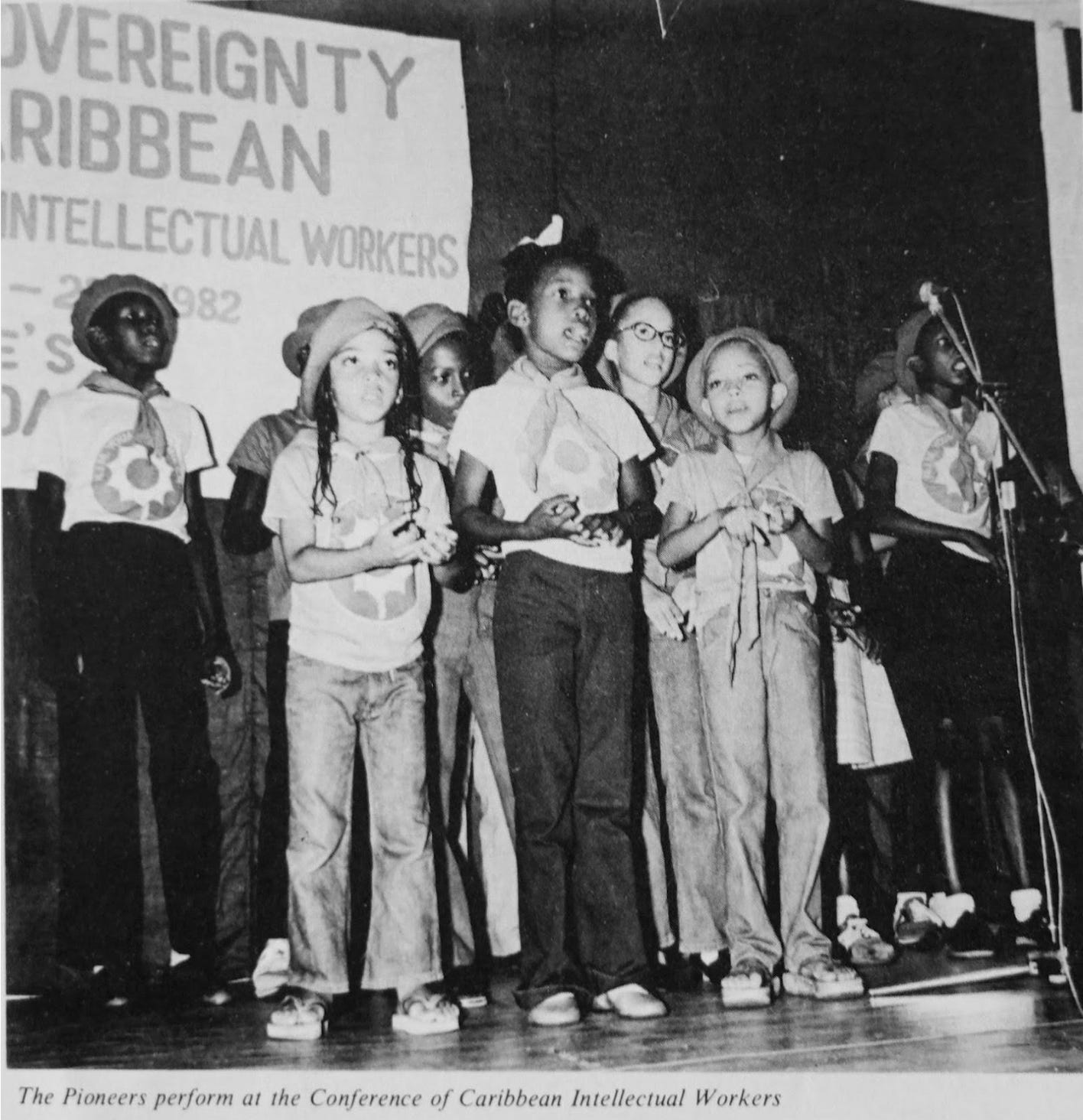
Grenadian Young Pioneers perform at the Conference for Intellectual Workers, 1984.
At TLC, we are learning to take more seriously our role in helping the movement to produce culture. To run classes on playwriting, songwriting, and design, and to bring together international comrades to share their experiences, we are officially launching our paid subscription tiers today. You can read our full strategy here.
Put simply, we want to equip you with the tools to make our movement fierce.
What you get by upgrading for £5/month today:
The Monthly Round-Up: Comprehensive curation of Left writing in Britain. (This May edition and next month’s June edition are free to all readers, but starting in August, these will be strictly for paid subscribers).
Curated Syllabus: Deepen your political education.
Exclusive Interviews: Learn from comrades organizing outside Britain.
Study Groups: Gain access to our collective study sessions.
May Round-Up
Here’s our round-up of writing on the Left in Britain from the month of May - we’ll give you May and June for free, but future round-ups will be for paid tiers. It’s a well-intentioned and imperfect representation of the whole, and you can complain that we included this and not that, and that we’ve misunderstood the other, using this form.
Here goes!
On the Far-Right and Fascism:
The Morning Star published a sober editorial after the election, calling on unions to force the Labour party to nationalise water and energy, cut bills, and build council houses, and urging them to resource trades councils and link community campaigns to workplaces. Bill Greenshields outlined the Together Alliance’s strategy against the far right: demonstrations, an anti-racist cultural sphere, workplace and community mobilising committees, training and education, and the building of movement infrastructure. Glyn Robbins described how Together on Cable Street is organising public meetings, history walks, cultural events and school activities to challenge racism.
Adam C. Jones wrote for Prometheus about Engels’ concept of ‘social murder’, arguing that fascist politics is a libidinised practice of cruelty, which responds to and delights in capitalist violence. While praising aspects of Jones’s analysis, David Renton noted that non-fascist reactionary movements also commit social murder, and argued that comparing our present moment to the interwar era is more useful for understanding broad dynamics of rightward radicalization than for comparing individual leaders. Richard Hames reported for Novara Media on a Tommy Robinson march, finding a heterogeneity of political beliefs among the participants. Richard Seymour analysed ecofascism. Tom Gann investigated how concepts of productive and unproductive classes are used by Left and Right populists, particularly in relation to housing, and how housing problems might become polarised to the right.
May 2026 saw more thoughts about The Party, whichever party you think that might be:
Fight for a Future blamed the Greens’ tepid reformism and its left wing’s avoidance of internal struggles and self-criticism on a desperate desire for electoral victory following years of Labour infighting and defeats. Elaine Graham-Leigh wrote for Counterfire that the Green Party is fundamentally tied through the class interests it represents to a pro-Nato position and a distrust of the masses, and is likely to compromise on its principles to gain parliamentary power. In the Weekly Worker, Carla Roberts was frustrated that the Greens bowed to pressure on alleged anti-Semitism. Joe Todd wrote for Novara that Polanski should follow Mamdani’s method of countering accusations of anti-Semitism. Richard Seymour thought Polanski should instead follow Mélenchon’s method. David Renton reflected on the experience of an Islington campaign team in their local elections, and their frustration with Your Party and the Greens.
In the Weekly Worker, in a contribution covering muckle historical and theoretical ground, Mike MacNair scrieved that those standing against ‘factionalism’ in Your Party and outside it are incorrectly avoiding explicit socialist or communist politics, in favour of labour or broad-left coalitions that will inevitably succumb to either liberalism or what he calls patriarchalist nationalism. Macnair finished his three-part series on factionalism with a criticism of Mandelite projects of new broad Left parties and an expressed desire for marxists to unite around a political programme which invites open and long-lasting factions and debates. Carla Roberts called for branches in Your Party to be allowed to take political initiative, against a backdrop of a lack of branch democracy. Roberts criticised the treatment of dual membership in Your Party and the official optimism coming from the leadership. Roberts also slated YP for failing to take on the May elections.
Ewan Tilley praised Mike Macnair and the CPGB-PCC for defending ‘Partyism’ (a position in favour of a broad, open, democratic Marxist party), but claimed they arrived at their organisational form and programme through theoretical models rather than historical materialist analysis, and advocated a thorough analysis of the class composition of the working class in Britain as a necessary precursor to the proposal of party forms and programmes. In a separate article covering similar ground, Tilley advanced a number of criticisms of existing Left organisations, claiming they fail to respond to or even analyse the real conditions of the working class. Daniel Moir built on Tilley’s work by considering the possibility of a mass strategy, and how it might be formed by a democratic multi-tendency organisation.
Learning new lessons from the 1926 General Strike:
Drawing on James Klugman’s historical account, Philip English wrote for Challenge Magazine that current workers’ movements can learn from 1926 about the correct relationship to the capitalist state, how to make strategic alliances, and the necessity of communist leadership. Aslef’s general secretary Dave Calfe wrote for the Morning Star about rail workers’ role in the strike. Dylan Murphy argued in the Morning Star that the 1926 general strike demonstrated the revolutionary potential of the working class but exposed a lack of rank-and-file power in the movement, opening the doors to betrayal. For Red Pepper Magazine, Joe Redmayne told stories of on-the-ground organising in 1926.
In the Weekly Worker, Jack Conrad questioned the meaning of the 1926 defeat, going on to analyse the conditions of the internal debate within the CPBG at the time, refuting the argument that the CPGB’s strategy was dictated by Stalin, and the argument that the Communist movement should have broken with the trade union movement. He ended the series by asking what the Communist Party should have done in 1926.
For RS21, Sylvia M found in Harry Wicks’ first-hand account evidence of an enthusiastic working class betrayed by its leaders, and Andrew Stone criticised the treachery of the TUC, describing a massive potential in the strike, and a defeat we should learn from.
Also in the month of May:
▪️Jonathan Shafi analysed the aftermath of the Holyrood 2026 election to argue that Scotland is experiencing a profound democratic recession, illustrating how austerity and the decline of collective life have produced a corporate-managerial politics. Shafi further reflected on how the Murrell embezzlement scandal obscures a much more serious theft by the SNP political class, of the working class political agency that was built up through the Yes movement.
▪️Jon Cink wrote from prison about being charged with terrorism, for Electronic Intifada
▪️John McEvoy wrote for Declassified UK on new documents showing the British secret service’s operations against anti-colonial organising during the Cold War.
▪️ Tim Llewellyn reviewed Killing Corbynism: Zionism’s War on Socialism by Rebecca Gordon-Nesbitt, for Electronic Intifada. Jody McIntyre laid out the history of Starmer’s ties to Israel.
▪️Fred Bayer argued that the STUC’s cuts to its congress cycle are inconsistent with its politics, and that the affiliates should step up their funding to retain an annual congress and the equalities congresses.
▪️Nigel Flanagan took a sceptical look at a reported increase in trade-union density, pointing out the overwhelming concentration in the public sector and in the older workforce. He argued that a coming period of mass unemployment and legal restrictions can only be bad for the unions, which as of yet have no political plan.
▪️Ewan Tilley criticised Modern Monetary Theory.
▪️Eddie Ford made a searing attack on the CPB.
▪️David Renton wrote articles around the subject of his recent book on Revolutionary Forgiveness, on Marx and ethics, Arkadi Kremer, Friedrich Adler, György Lukács, and an overview of the book itself.
▪️Theryn Arnold wrote about how to understand China; Ewan Tilley wrote a response, so did Lyra S.
▪️Prometheus published a roundtable on the war on Iran.
▪️Louis Boyd-Madsen and Paul Dobson investigated who makes money from Scotland’s wind farms.
And that’s a wrap!